
Buyer Journey Overview
Where is your buyer right now?
Every marketing problem sits somewhere in the buyer’s journey.
The question is not which capability to buy.
It is which stage of the journey needs attention – and whether the foundation at that stage is sound enough to build on.
THE SEQUENCING TRAP
The most expensive mistake in marketing is not choosing the wrong channel. It is investing in the wrong stage of the journey.
- Driving more traffic to a funnel that cannot convert.
- Nurturing leads that were never properly qualified.
- Closing deals from a positioning that the market has not confirmed.
- Retaining customers whose onboarding experience has already created the conditions for churn.
Each of these produces activity. None of them produces the compounding result the investment was designed for.
Before investing in a stage, it is worth confirming that the stage upstream of it is working.
That is the question Qallann Marketing asks before recommending where to build.
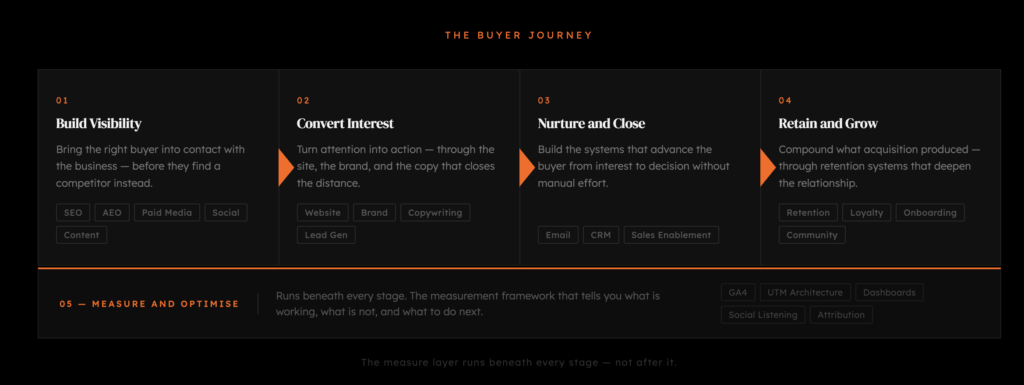
THE FIVE STAGES OF THE BUYER JOURNEY
01
Build Visibility
Bring the right buyer into contact with the business.
The buyer cannot choose a business they have not found. Visibility is the precondition for everything downstream. But visibility built around unclear positioning attracts the wrong buyer – which makes every downstream stage harder and more expensive.
Before investing in visibility, confirm: Is the positioning clear enough that the right buyer will recognise themselves in what they find?
Capabilities at this stage
This is the most expensive stage to get wrong – and the one where most businesses invest least in examination.
02
Convert Interest
Turn attention into action.
The buyer has found the business. Now the site, the copy, and the brand need to do the work of moving them from interest to decision. This is where unclear positioning shows up as a conversion problem – and where businesses most commonly invest in the wrong fix.
A redesigned website does not fix a positioning problem. Better copy does not fix an unclear offer. The conversion capability works when the foundation beneath it is confirmed.
Before investing in conversion, confirm: Does the buyer understand why this business should be chosen over everything else available to them?
Capabilities at this stage
If positioning clarity is needed first:
If the build assumptions need confirming:
03
Nurture and Close
Build the systems that move buyers from interest to decision.
Not every buyer decides immediately. The nurture stage maintains the relationship between first contact and commercial decision – advancing the buyer’s understanding without manual effort from the sales team.
When the nurture system is built on an unconfirmed customer journey, it moves buyers through a sequence that was never designed for them. The emails go out. The leads are followed up. The results are inconsistent.
Before investing in nurture and close, confirm: Is the customer journey mapped from the buyer’s entry point – not from the business’s exit point?
Capabilities at this stage
04
Retain and Grow
Keep the customers acquired and compound what acquisition produced.
Acquisition produces customers. Retention produces compounding.
A business that invests heavily in the first three stages without a designed retention system keeps replacing customers it is quietly losing – which requires continuously increasing the acquisition budget to maintain flat revenue.
The retention stage is where most businesses underinvest – not because the opportunity is unclear, but because the urgency is not loud. The cost accumulates slowly and invisibly until it is not.
Before investing in retention, confirm: Is there a clear picture of what existing customer relationships are actually producing commercially – and where the value is being lost?
Capabilities at this stage
05
Measure and Optimise
Know what is working, what is not, and what to do next.
Measurement is not a stage that comes after the others. It runs underneath all of them – providing the data that tells the business whether each stage of the journey is performing and what needs to change.
Without a measurement framework built around commercial outcomes, the journey produces reports rather than decisions. Activity metrics that describe what happened without telling the business what to do next.
The right measurement framework answers one question: Is the investment at each stage of the journey producing the commercial outcome it was designed to produce?
Capabilities at this stage
WHAT THIS MEANS IN PRACTICE
Not sure which stage needs attention first?
The answer is almost always: start one stage upstream of where the problem appears.
- If conversion is low – examine visibility and positioning.
- If nurture is not working – examine the customer journey and the offer.
- If retention is weak – examine the onboarding experience and the post-sale design.
- If measurement is unclear – examine what commercial outcomes the system was designed to produce.
And if the constraint is not visible in the funnel at all (if activity is high across all stages and results are still flat) the constraint is likely upstream of the journey entirely.
The journey works when each stage is built on a confirmed foundation.
Find your stage. Confirm the foundation. Then build.